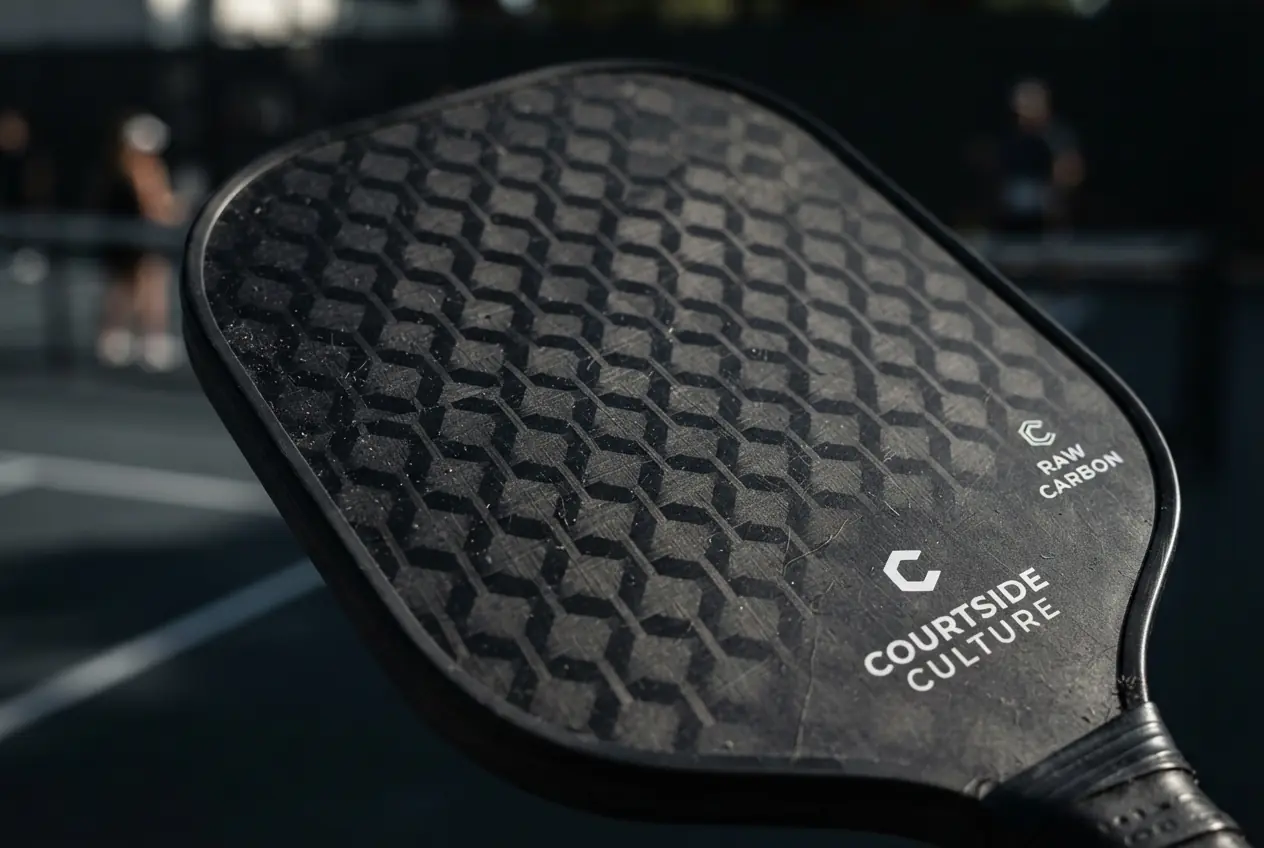
Most paddle shopping starts and ends with face material — carbon vs. fiberglass, textured vs. smooth. But two paddles with the same face can play completely differently depending on two numbers that get far less attention: grip size and weight. Get either one wrong and no amount of carbon fiber will fix how the paddle feels in your hand.
GRIP CIRCUMFERENCE
CORE & BALANCE
How to Measure Your Grip Size
The standard method: measure from the middle horizontal crease of your palm up to the tip of your ring finger, with your fingers extended. That distance in inches is roughly your ideal grip circumference. Most adult players measure somewhere between 4.0in and 4.5in.
If you already have a paddle to test, there's a simpler physical check: slide the index finger of your non-dominant hand into the gap between your ring finger and the base of your thumb while your dominant hand holds the grip normally. The fit is right when that finger slides in snugly — not loose, not wedged in.
Standard pickleball grip circumferences, and who they typically fit:
- 4 1/8in (4.125in): Small. Common for players with smaller hands, frequently the default on women's-marketed paddles.
- 4 1/4in (4.25in): Standard. The most common size on the market and the safest default if you haven't measured.
- 4 3/8in (4.375in): Large. Less common, useful for players whose measurement runs past 4.25in.
- 4 1/2in (4.5in): Very large. Mostly seen with players transitioning from tennis, where grips run larger.
If you're between two sizes, the general advice is to size down rather than up: a slightly small grip is a quick, cheap fix with an overgrip wrap (adds roughly 1/16in per layer), while a too-large grip limits wrist snap on spin shots and is much harder to correct after the fact.
Static Weight Categories
Static weight is simply what the paddle weighs on a scale, and it's the number printed on every spec sheet. The market generally splits into three bands:
- Lightweight (under 7.3oz): Fastest hands at the net, easiest resets, generally the least forgiving on power since there's less mass behind the ball.
- Midweight (7.3–8.3oz): The most common range and generally considered the most beginner-friendly, balancing paddle speed with enough mass to drive through the ball.
- Heavyweight (8.3oz and up): More built-in power with less swing effort, often preferred by players transitioning from tennis or racquetball where heavier rackets are the norm. The tradeoff is slower hands at the net.
Most paddles on the market today cluster in the 7.3–8.5oz range — genuinely ultralight or heavyweight paddles are the exception rather than the rule.
Swing Weight Explained
Static weight is only half the picture. Swing weight is how heavy the paddle feels in motion, and it depends on how mass is distributed across the frame, not just the total amount. Two paddles that weigh exactly 8.0oz on a scale can feel completely different swung through a volley if one concentrates weight toward the head and the other toward the handle.
A head-heavy paddle (more mass toward the top) has a higher swing weight: it feels more powerful and stable on drives, but slower to bring back into position for a fast exchange at the net. A handle-heavy or evenly-balanced paddle has a lower swing weight: quicker to maneuver, with less built-in power on its own.
Swing weight is typically measured on a scale from roughly 90 to 130:
- Very light: 90–104 — fastest hands, least power
- Light: 105–111
- Average: 112–118 — where most all-around paddles land
- Heavy: 119–124
- Very heavy: 125–130+ — maximum power, slowest to reset
Swing weight is rarely printed on retail packaging the way static weight is, which is part of why two "midweight" paddles from different brands can feel nothing alike in-hand. When a spec sheet doesn't list it, published reviews and community paddle databases are usually the only way to get a sense of it before buying.
Two paddles can weigh exactly the same on a scale and still feel completely different in your hand — that's swing weight, not static weight, doing the work.
Putting It Together
For most players building a first or second paddle, a reasonable starting point is a standard 4.25in grip and a midweight static weight (7.3–8.3oz) — the range with the widest selection and the easiest resale or trade-up path if it's not quite right. From there:
- If your hands are on the smaller side or you prioritize touch and reset shots, look toward the lighter end of midweight, or a true lightweight paddle with a 4.125in grip.
- If you're coming from tennis, racquetball, or another racket sport and want a more familiar heft, a heavier paddle (8.3oz+) with a larger 4.375–4.5in grip will feel more natural, at some cost to hand speed at the net.
- If you can't test swing weight directly, published reviews that describe a paddle as "head-heavy" or "maneuverable" are a reasonable proxy — head-heavy tends toward higher swing weight and more power, maneuverable tends toward lower swing weight and faster hands.
Paddles by Weight Category
Three paddles from our 2026 paddle comparison that illustrate the range:
Paddletek Bantam TS-5
~$90Lightweight build (7.0–7.5oz) for fast hands and quick resets
JOOLA Ben Johns Perseus CFS 16mm
$160–230Midweight (~8.0oz) with a 16mm core built for control at the net
Selkirk Vanguard Power Air Invikta
~$250Midweight (7.7–8.1oz), elongated shape, 4.25in grip circumference
Notice that paddle's elongated shape in the spec line above — a longer, narrower face changes the weight-and-grip math further, since the added length shifts swing weight toward the head even at a similar static weight. If that shape interests you, our elongated paddle guide covers five real options.
Conclusion
Face material determines how a paddle plays on contact; weight and grip determine whether it feels right in your hand for the two hours you're actually holding it. Measure your grip before you buy, start in the midweight range unless you have a specific reason not to, and treat swing weight as the tiebreaker between two paddles that look identical on paper. For the material side of the equation, see our carbon vs. fiberglass breakdown, or browse the full paddle hub.